What Is a DEXA Scan and Who Should Get One?
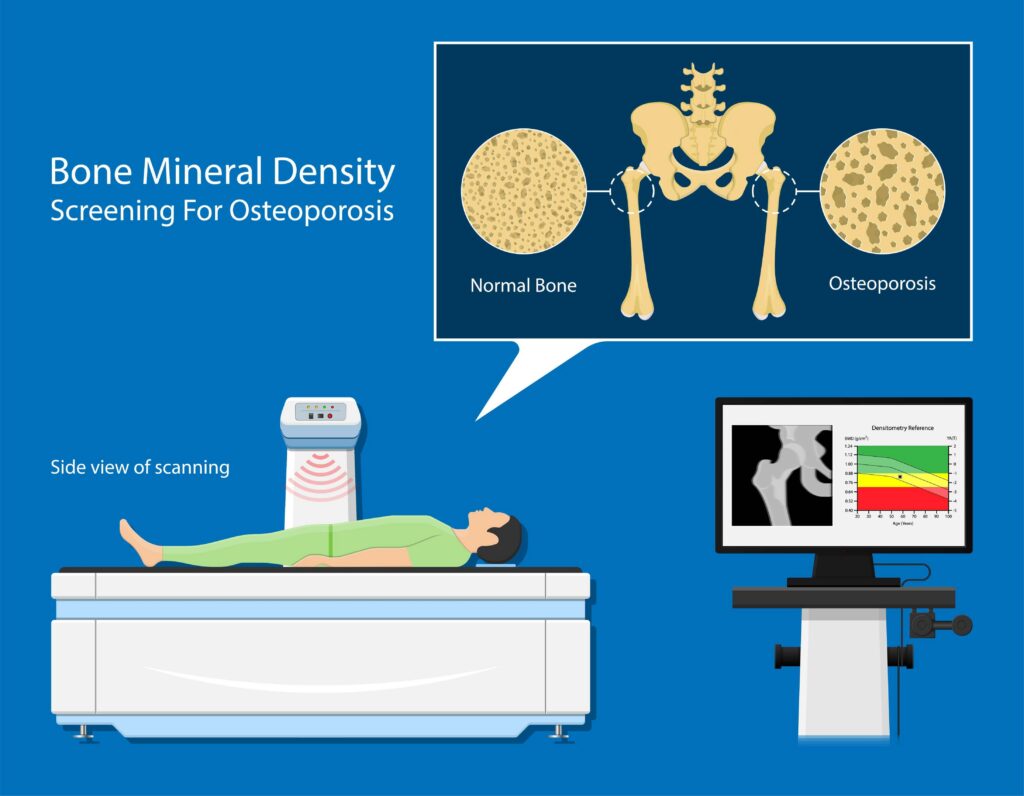
A DEXA scan is a quick, low-dose X-ray test that measures how much mineral is packed into your bones, which is the best available predictor of your future fracture risk. Screening is recommended for all women 65 and older, and for postmenopausal women under 65 at increased risk. It’s also commonly ordered for anyone who has broken a bone from a minor fall, takes long-term steroid medication, or has a suspected spinal compression fracture.
In this post, we’ll be discussing what the scan involves, who the guidelines say should have one, the reasons a spine practice like ours orders them, and what to expect on the day of said scan. Read on to learn more!
What a DEXA Scan Is, and What It Isn’t
DEXA stands for dual-energy X-ray absorptiometry. The scanner passes two low-energy X-ray beams through the bone, and the difference between them reveals how dense that bone is. Your results come back as a bone mineral density measurement, usually from the lumbar spine and one or both hips.
Just as useful is knowing what a DEXA scan is not:
It’s Not an MRI or a CT Scan: DEXA measures bone density only. It won’t show a herniated disc, a pinched nerve, or the soft tissue detail those scans provide.
It Won’t Explain Your Back Pain on Its Own: A DEXA scan tells us how strong your bones are, which is a piece of the puzzle rather than the whole picture.
It’s Not a Tunnel: You lie on an open padded table while an arm passes above you. There is no enclosed space and no injection.
For the practical details on scheduling and what the appointment involves, our DEXA scan page covers the most common questions we receive.
Who Should Get a DEXA Scan?
Screening guidelines and clinical practice both play a role here. The U.S. Preventive Services Task Force (USPSTF) recommends screening for osteoporosis in all women 65 years or older, and in postmenopausal women younger than 65 whose fracture risk is elevated based on a clinical risk assessment. For men, the Task Force concluded the evidence is insufficient to make a general screening recommendation, which is not the same as saying men never need the test. Men with risk factors or a history of fracture are frequently scanned in practice.
Beyond age-based screening, certain situations move a DEXA scan up the priority list:
A Fracture After Age 50 from a Minor Fall: Breaking a bone from standing height or less is one of the strongest signals that bone strength is a concern.
Long-Term Steroid Use: Oral corticosteroids taken for several months or more are a well-known cause of bone loss.
Height Loss or a New Stooped Posture: Losing more than an inch and a half of height can indicate compression fractures that occurred without obvious symptoms.
Medical Conditions That Affect Bone: Rheumatoid arthritis, an overactive thyroid or parathyroid, celiac disease, inflammatory bowel disease, prior bariatric surgery, chronic kidney disease, and certain cancer treatments all affect bone density.
Early Menopause: Menopause before age 45, whether natural or surgical, shortens the window of estrogen’s protective effect on bone.
Is a DEXA Scan Worth Discussing at Your Next Visit?
Check anything below that applies to you. The result is a starting point for a conversation with your provider, not a diagnosis.
Your result will appear here
Check any statements on the left that apply to you.
A DEXA scan is likely appropriate for you
What you selected falls within the situations where bone density testing is commonly recommended. Ask your provider about scheduling one, or reach out to us directly.
Or call our office at 210-255-8935.
Worth raising at your next visit
What you selected can increase bone loss risk without automatically meaning you need a scan today. Your provider can weigh these against your full history and decide whether testing makes sense now.
This checklist reflects common screening criteria. It is not a diagnosis, does not replace medical advice, and your answers stay on this page.
Why a Spine Practice Orders DEXA Scans
Bone density testing is often thought of as something a primary care provider or a gynecologist handles, yet it matters a great deal in spine care specifically.
Compression Fractures Start with Weak Bone: When vertebrae lose density, a minor fall, a hard cough, or lifting something light can be enough to cause one to collapse. Knowing your bone density helps explain why a fracture happened and how likely another one is.
Surgical Planning Depends On It: Screws and other hardware need solid bone to hold securely. Knowing your density in advance can change the recommended technique and improve the safety of a planned procedure.
Silent Fractures Are Common: Many vertebral compression fractures never cause dramatic pain. Height loss and a rounding upper back are sometimes the first clues, and a scan helps clarify what’s happening.
If you’re dealing with a suspected fracture right now, our team offers emergency compression fracture treatment. Our post on the benefits of DEXA scans beyond osteoporosis covers the other information the test can provide.
What to Expect During Your Scan
The appointment itself is straightforward:
No Special Preparation: You can eat and drink normally. Your provider may ask you to skip calcium supplements on the day of the scan, since they can affect the reading.
Dress Simply: Wear comfortable clothing without zippers, snaps, or metal buttons near your hips and lower back. You may not need to change at all.
It’s Quick and Painless: You lie still on a padded table while the scanner arm passes over you. The whole visit typically takes about 15 minutes.
The Radiation Dose Is Very Low: A DEXA scan uses a small fraction of the radiation of a standard chest X-ray. Let your provider know if you are or may be pregnant.
Tell Them About Recent Imaging: Contrast dye from a recent CT scan or barium study can interfere with the results, so mention any recent tests when you schedule.
What Happens After the Scan
Your results arrive as a T-score, and sometimes a Z-score, for each site measured. The T-score compares your bone density to that of a healthy young adult, and as the National Institute of Arthritis and Musculoskeletal and Skin Diseases (NIAMS) explains, the lower that score, the higher your fracture risk. The Z-score compares you to others of your own age and sex. Our guide to understanding your DEXA results walks through both numbers in detail.
Your provider reads those scores alongside your age, history, medications, and fall risk, then discusses what makes sense next. For many patients that means activity and nutrition changes with a follow-up scan down the road. For others it means further testing or a conversation about treatment.
Frequently Asked Questions
At what age should I get my first DEXA scan?
Guidelines recommend screening for all women at 65, and earlier for postmenopausal women with elevated fracture risk. Men are often scanned at 70, or earlier when risk factors are present. Anyone who fractures a bone from a minor fall after age 50 should be evaluated regardless of age.
Is a DEXA scan covered by insurance?
Bone density testing is widely covered when you meet recognized screening criteria, and Medicare covers it for qualifying patients at set intervals. Coverage rules vary by plan and by how often you have been scanned before, so it’s worth confirming with your insurer or our office before scheduling.
Does a DEXA scan hurt?
No. You lie on an open padded table, fully clothed in most cases, while a scanner arm passes above you. There are no injections, no enclosed space, and nothing to feel. The most difficult part for most people is simply staying still for a few minutes.
Do men need DEXA scans?
The USPSTF found insufficient evidence to recommend routine screening for all men, yet men do develop osteoporosis and fracture from it. Men with prior fractures, long-term steroid use, low testosterone, or other risk factors are commonly scanned, and many clinicians screen men starting at age 70.
How long does a DEXA scan take?
The scan itself takes only a few minutes per site, and the full appointment usually runs about 15 minutes from check-in to finish. You stay dressed in most cases, so there is little preparation time, and you can return to your normal activities immediately afterward.
How often should a DEXA scan be repeated?
That depends on your results, your risk factors, and whether you have started treatment. Bone changes slowly, so repeat testing is generally spaced out, and insurance coverage rules may affect timing. Your provider will recommend an interval, ideally on the same machine for reliable comparison.
Find Out Where Your Bone Health Stands
A DEXA scan is quick, painless, and one of the most useful preventive tests available, especially if your spine health is already on your mind. If you’d like to know whether one makes sense for you, you’ll want to contact us using the form below or call our office at 210-255-8935. We’ll be sure to respond as soon as possible. We look forward to hearing from you soon!
DISCLAIMER: No content on this site, regardless of date, should ever be used as a substitute for direct medical advice from your doctor or other qualified clinician.